Civic Participation and Urban Development in Starnberg
Civic Participation & Urban Development in Starnberg: What’s Next – and How You Can Effectively Contribute
What could Starnberg look like in the coming years if decisions on mobility, the city center, and neighborhoods are consistently aligned with the needs of local people? Modern civic participation provides the framework for this: transparent, early, and with a comprehensible impact on planning.
Why Civic Participation is Crucial for the Next Development Steps
Urban development in Starnberg in the coming years is above all a question of priorities: Which goals take precedence when space is scarce, traffic is changing, climate adaptation is becoming more important, and public spaces are expected to meet diverse needs?
Civic participation can achieve three things that pure information policy cannot:
- Utilize everyday knowledge: Routes, bottlenecks, noise situations, places to stay, and conflicts are often described more precisely by residents than by any existing map.
- Increase acceptance: When alternatives are visibly weighed, the risk that projects later fail due to resistance or misunderstandings decreases.
- Improve quality: Good participation provides verifiable indications: Where is compensation needed, which uses fit, which measures are socially acceptable?
Which Planning and Participation Phases Typically Come Next
Regardless of the specific project (city center, neighborhood, mobility, or public space), good urban development usually follows a clear sequence in the next steps. For you as a citizen, this is important because opportunities for influence vary greatly depending on the phase.
1) Orientation & Target Image
In this phase, the problem definition and goals are sharpened: What is to be achieved (e.g., traffic relief, better quality of stay, climate adaptation, barrier-free routes)? Influence is particularly great here, as several solution directions are still open.
2) Variants & Evaluation
Several variants are developed (e.g., different traffic routes, usage and open space concepts). Participation is most effective when it not only collects opinions but also clarifies criteria: safety, noise, costs, accessibility, ecological impact, social consequences.
3) Design & Preferred Variant
The planning is consolidated into a preferred design. Feedback with justification is important: Which suggestions were adopted – and why were others not adopted (e.g., for safety, environmental, cost, or legal reasons)?
4) Formal Steps (if land-use planning is involved)
If a project triggers land-use planning, legally regulated participation phases follow. In these phases, you can submit comments that must be included in the evaluation. The clearer you refer to planning documents, impacts, and alternatives, the stronger your contribution.
5) Implementation, Monitoring & Adjustment
Implementation involves scheduling, construction phases, accessibility, and side effects. Reliable monitoring (e.g., traffic counts, observation of public space usage, safety indicators) provides the basis for later adjusting measures.
What Rights You Have (and What the Limits Are)
In Germany, public participation in land-use planning is legally anchored. Particularly relevant are:
- Early public participation (goals, purposes, significant impacts; opportunity for expression and discussion).
- Formal participation/plan display (inspection of documents; comments within the deadline).
Important: Participation does not mean that every individual position is implemented one-to-one. The law provides for a balancing of various public and private interests. This is where transparency arises: You can understand how arguments were assessed – and you can formulate your perspective so that it stands up to evaluation (e.g., with concrete impacts, alternatives, and evidence).
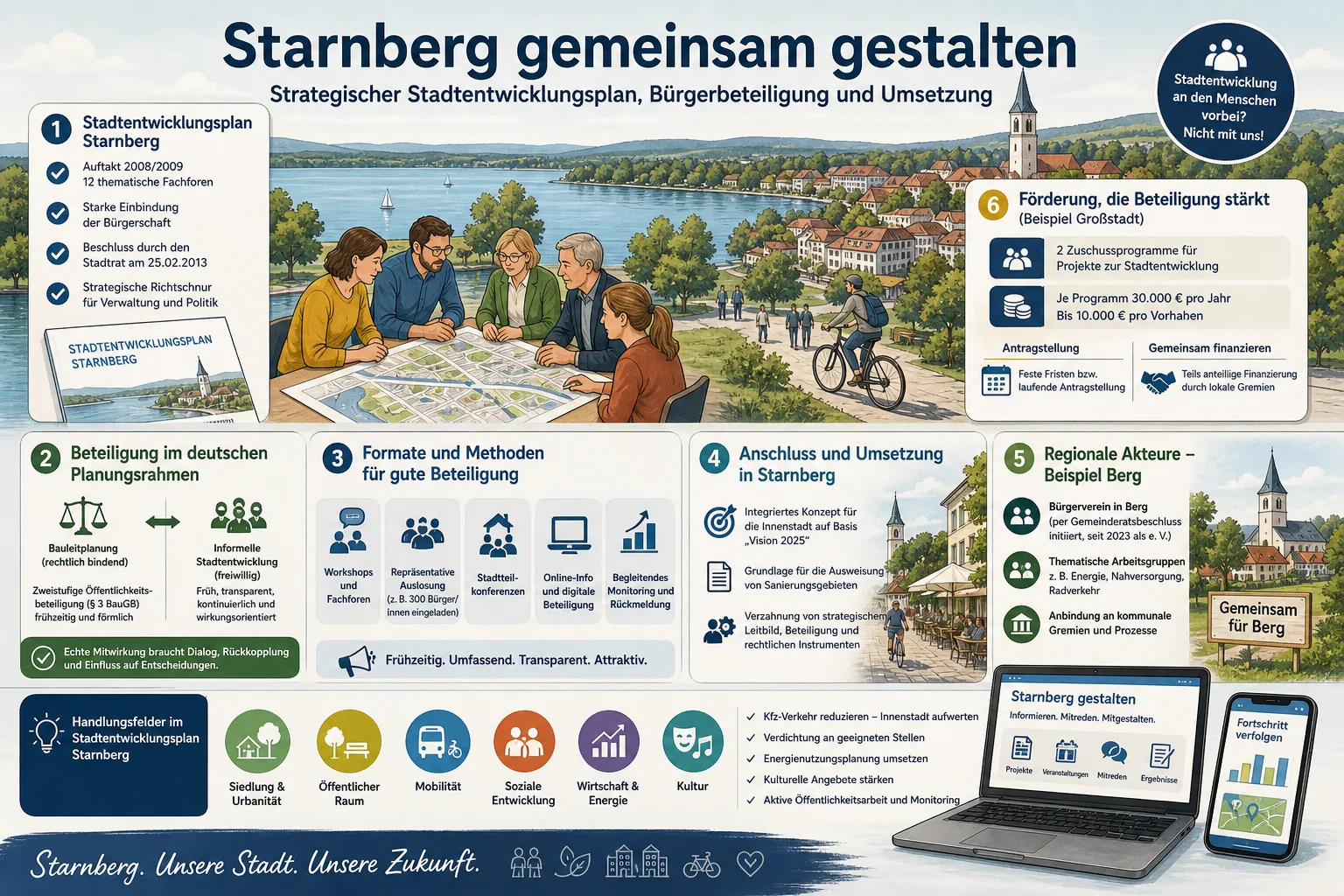
Formats That Make Sense in Starnberg: In-person, Digital, Random Selection
For the upcoming participation steps in Starnberg, formats are particularly suitable that enable both depth (qualitative discussion) and breadth (diverse participation):
- Workshops/planning workshops: Working on maps, variants, and criteria catalogs; suitable for neighborhood topics, squares, mobility hubs.
- Neighborhood or district walks: On-site observations of safety, barriers, quality of stay; especially helpful for specific problem areas.
- Online participation: Map comments, surveys, documents; important for people with little time and as transparent documentation.
- Randomly selected participation (citizens’ council approaches): Randomly selected participants can represent a cross-section; suitable when the debate is highly polarized or very complex.
- Round tables with interest groups: In addition to open formats, for example for accessibility, youth, seniors, businesses, cycling and walking.
Good practice is a combination: open participation (low entry barriers) plus randomly selected/structured formats (balanced representation) plus digital documentation (traceability).
How to Recognize if Participation Really Has an Impact
So that participation in the next procedures does not stop at just “being there,” three elements should be visible:
- Clear guiding questions: What is the participation for (goals? variants? design? priorities? accompanying measures?)
- Transparent decision criteria: According to which criteria is the evaluation made (safety, environment, costs, social impact, accessibility, monument protection, noise)?
- Binding feedback: An understandable evaluation (“What was adopted? What not? Why?”) and a publicly accessible protocol.
A practical tool is a publicly accessible “measures list” with status (under review, decided, in implementation), responsibility, and next decision date. This makes it clear how contributions become concrete steps.
How to Prepare Your Contribution: 7 Practical Steps
- Name the location precisely: Street, section, intersection, square – ideally with a brief description (e.g., “school route,” “bottleneck,” “missing crossing”).
- Describe the impact: What happens today – and for whom is it problematic or good (children, elderly, cyclists, public transport users, residents)?
- Formulate a goal instead of just a measure: e.g., “safe crossing,” “reduce noise,” “improve stay.”
- Suggest an alternative: If you are against a solution, name a realistic option (or conditions under which it could work).
- Provide brief evidence: Photo, sketch, measurement note (e.g., observation times), experience report from several households – without personal data.
- Pay attention to evaluability: Address costs, safety, accessibility, environmental impacts – and acknowledge possible goal conflicts.
- Stay involved: Read feedback and protocols, ask questions if justifications are unclear, and use follow-up appointments for clarifications.
Topics That Will Be Especially Relevant in the Coming Years
The following topics will typically be at the center of future urban development in Starnberg, as they touch on many goals at once:
- Mobility & Safety: Safer school routes, conflict-free guidance for pedestrian and bicycle traffic, efficient public transport connections, and a coherent interplay with car traffic and delivery zones.
- Public Space & Quality of Stay: Squares, paths, and waterfront areas as everyday places (shade, seating, accessibility, orientation).
- Housing & Social Balance: How new forms of housing, intergenerational justice, and social infrastructure (daycare centers, meeting places) can be reconciled with space constraints.
- Climate Adaptation: Heat protection, heavy rain prevention, unsealing, urban greenery, and water management as fixed planning components.
- City Center Development: Accessibility, mixed uses, vacancy prevention, and attractive ground floors as a basis for vibrancy.
- Energy & Resource Conservation: Efficient neighborhood solutions and climate-friendly infrastructure – as evaluation factors in projects and concepts.
The more concretely participation connects these topics with locations, uses, and measurable impacts, the more likely decisions will be perceived as fair and comprehensible in everyday life.