Health Fairs & Fitness Events in Starnberg
Health Fairs & Fitness Events in Starnberg: What Awaits You in the Future – and How to Find Suitable Dates
6 min readLaura Müller
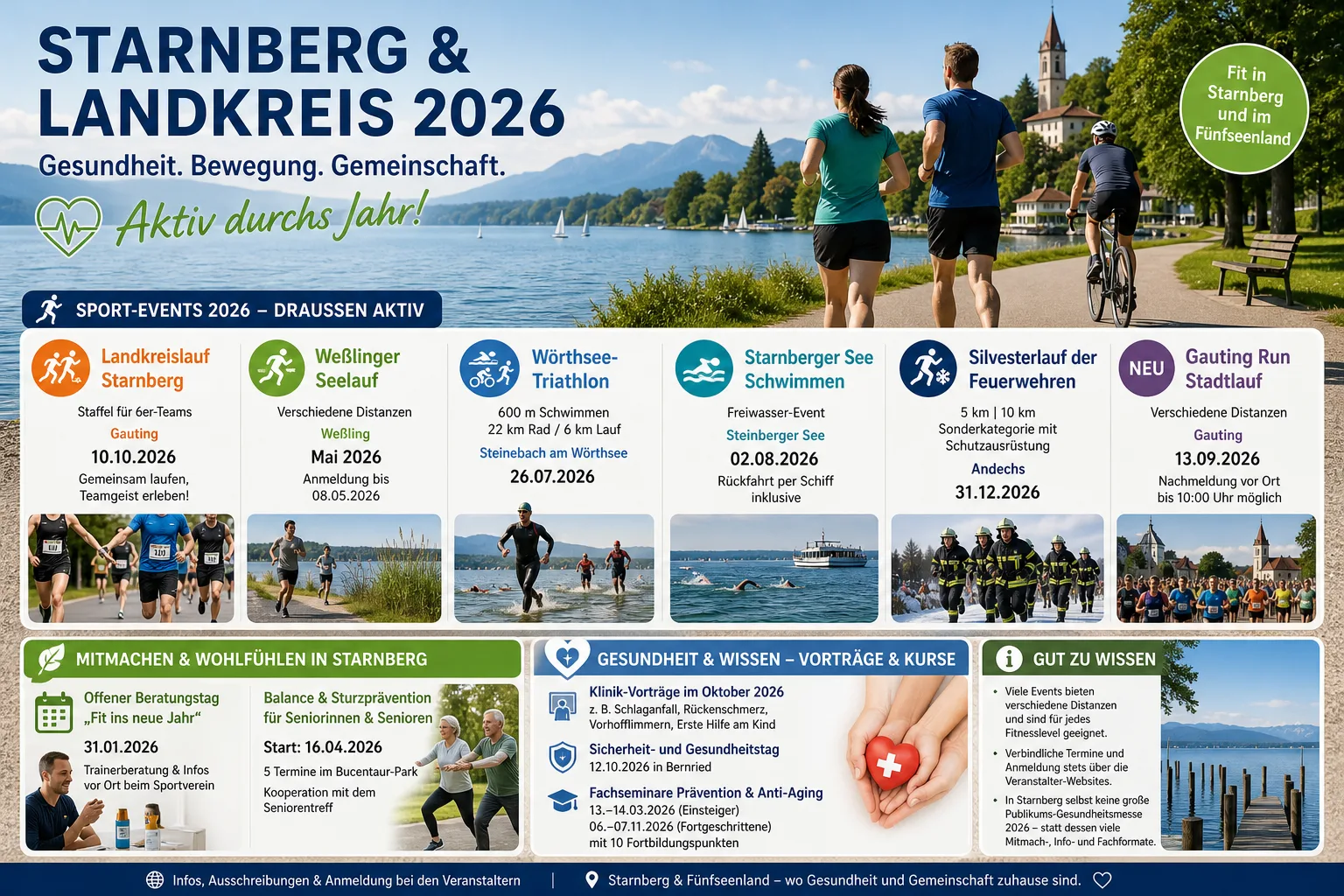
In Starnberg, there is usually not one big health fair in an exhibition hall – but rather many future fitness and health formats spread throughout the year: outdoors by the lake, in clubs, in clinics, and at specialist events. This guide shows you which types of events you can expect in the coming months and years and how to reliably research them.
Upcoming Running, Endurance, and Outdoor Formats Around the Lake
In the Starnberg area, outdoor formats are particularly obvious: lakeside paths, hilly routes in the surrounding area, and several lakes provide a backdrop that organizers regularly use for sports events. What formats can you typically expect in the future?
1) Running and Relay Events
In the coming years, fun runs and relay formats can regularly be found in the district. Relay models are particularly beginner-friendly: you share the total distance as a team, get the event feeling without an “all-or-nothing” pressure, and can choose a suitable distance.
2) Lake Runs and Circuits by Bodies of Water
Lake runs are popular because they offer predictable course profiles, good orientation, and high motivation: “Once around the lake” is a clear goal. Shorter distances or children’s runs are often added for families. If you are new, pay attention to categories such as fun run, Nordic walking, or beginner route when registering.
3) Triathlon and Multisport Formats
There may also be triathlon or duathlon formats around Starnberg in the future. For beginners, short distances are interesting because they keep training build-up and equipment requirements manageable. Check the participation conditions early (e.g., swimming certificate, equipment rules, briefing requirement), as these vary depending on the event.
4) Open Water Swimming
Open water events may also be offered in the coming seasons, often with several course lengths. Here, “speed” is less important than safety: temperature, visibility, start mode, buoy guidance, and rescue concept are key quality features. Serious announcements mention these points transparently.
Low-Threshold Offers: Participating Without Performance Pressure
Not everyone wants competition. Especially in Starnberg, formats aimed at health promotion in everyday life are often to be expected in the future: joint training, participation sessions, action days, or course series.
Consultation Days and Club Activities
Sports clubs and local providers may offer open dates in the future where you can get to know training options, ask questions, and compare course formats (e.g., fitness circuits, back training, endurance groups). This is especially helpful if you want to start again after a break and are looking for a safe entry.
Balance and Fall Prevention (Especially for Older People)
For seniors or people with uncertainty when walking, balance and strength programs are often relevant in the future. They address where prevention is measurable in everyday life: stability, reaction ability, safe movement sequences. Pay attention to qualified course instructors and clear target group descriptions in offers.
Important: Fall prevention is a medically relevant topic. If falls, dizziness, or neurological complaints already exist, prior medical clarification is advisable.
Clinic and Health Lectures: Knowledge, Prevention, Orientation
Public information evenings and patient lectures in clinics and health centers in the Starnberg area are also realistic in the future – often on common topics such as cardiovascular, orthopedics, pain, rehabilitation, or emergency knowledge.
How to Recognize Serious Medical Lectures
- Transparent speakers: Name, function, specialty, institution.
- Concrete learning objective: e.g., “Recognize warning signs,” “Understand treatment paths,” “Prevention in everyday life.”
- Limits & note: The lecture does not replace individual diagnosis/treatment.
- Current information: Update date or reference to guidelines/standards.
Action Days and Health Days
If clinics or rehab facilities offer health days, these are often “mini-fairs” in the best sense: compact, with short impulses, participation stations, and orientation on prevention. It is crucial that measurements and short checks are always clearly explained (what does a value mean, what does it not?) and do not create false security.
Specialist Seminars & Further Training: Prevention, Sports Medicine, Lifestyle
In addition to public events, specialist events can also take place in the region in the future, for example on prevention, training science, nutritional medicine, or sports medicine. These are often aimed at professionals (therapy, medicine, training), but are sometimes also open to interested laypeople.
If you want to participate as a private individual, check in advance:
- whether the seminar requires basic knowledge,
- whether content is promotional (e.g., product sales in the foreground),
- whether sources/guidelines are mentioned and how risks are handled.
How to Find Upcoming Dates Reliably (Checklist)
To really find future events (and not outdated entries), structured research helps. These sources are usually the most reliable:
- Official organizer websites (clubs, municipalities, clinics, event organizations) with date and announcement.
- Municipal event calendars (city/municipalities/district) – ideal for lectures and action days.
- Sports associations/series calendars (e.g., for running or triathlon dates) with linked original announcement.
- Current social media posts from organizers – helpful, but always cross-check with the official announcement.
Quality Check Before Registration
- Date, time, location clearly stated?
- Contact (email/phone) available?
- Participation conditions (age groups, safety rules, liability) clear?
- Cancellation rules understandable?
- Safety concept described for water and endurance events?
Participate Safely: Health, Training, Responsibility
Fitness and health events should motivate – not overwhelm. Simple principles apply for a safe start:
- Increase slowly: Gradually increase training volume, especially after a break.
- Take warning signs seriously: Chest pain, shortness of breath, dizziness, unusual weakness are reasons to stop exertion and seek medical advice.
- Be especially careful in open water: Realistically assess temperature, waves, orientation, and your own ability.
- Choose equipment appropriately: Shoes/helmet/neoprene only as needed and according to event rules.
Note: This article is for information purposes and does not replace medical advice. If you have pre-existing conditions or are unsure, consult a doctor or qualified professionals before intensive exertion.