Poetry Slams in Starnberg: Stage for Word Art and Slam
Poetry Slams & Word Art in Starnberg: What Awaits Audiences and Newcomers in 2026
Poetry Slam is live literature with a competitive element: self-written texts, limited time, immediate audience reaction. In the Starnberg district, interest in stage poetry is growing – and in the coming months, there will be particularly good opportunities to discover new formats, perform yourself, or get started in the scene with workshops.
Who is this guide for? For visitors planning a slam evening by the lake in 2026, as well as for writers (including U20) preparing for their first performance.
What Counts as a Poetry Slam – and Why the Format Works So Well
A poetry slam is a modern poetry competition. The key is the mix of text, performance, and a clear framework: Every voice gets a fair stage, and the audience is part of the decision. This very combination makes the format predictable for organizers and at the same time surprising for everyone in the room.
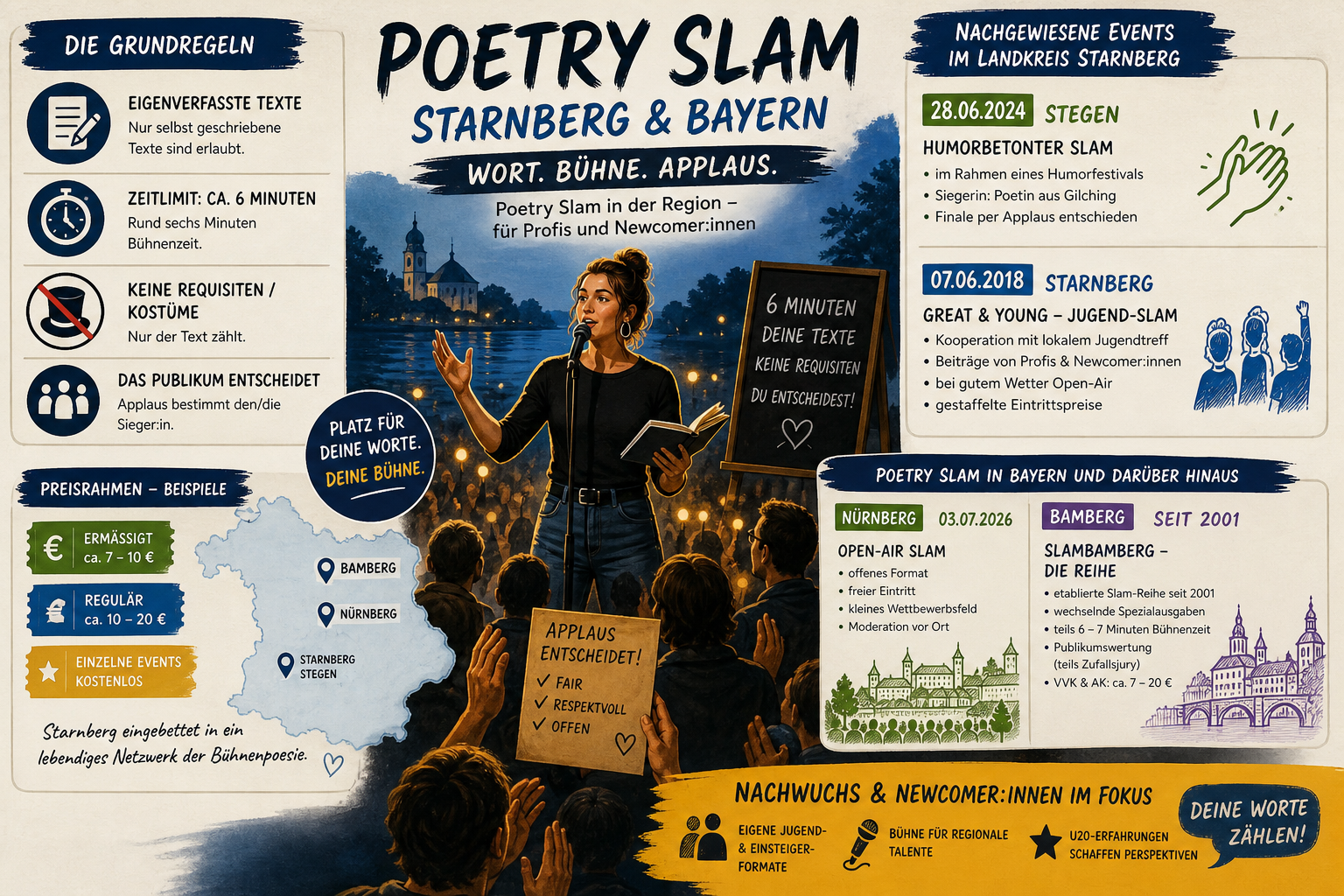
The Usual Basic Rules (with Small Local Variations)
- Only original texts: Only self-written material is performed (poetry, story, spoken word, humorous or serious texts).
- Limited stage time: Slots are often around 5–7 minutes. The exact time is communicated by the host.
- Focus on words & delivery: In many formats, props and costumes are excluded or heavily restricted to keep performances comparable.
- Audience decides: Depending on the evening, by applause, hand signals, or a random jury from the audience.
For 2026, this means in practice: If you attend a slam event in Starnberg or the surrounding area, you can very likely rely on a clear structure – even if details (time limit, scoring) vary from night to night.
What Makes Sense in Starnberg in 2026: Formats That Fit Well Now
Without being tied to individual, fixed dates, three realistic event directions can be described for the Starnberg district that are particularly suitable and frequently requested for 2026:
1) Slam Evenings in Cultural Venues and Smaller Stages
Indoors (cabaret, cultural center, theater/stage space), the classic slam works most reliably: good acoustics, controllable light and sound conditions, clear dramaturgy with preliminary rounds and finals. For guests, this means: high text density, focused atmosphere, and a well-moderated show.
2) Open-Air Word Art by the Lake (Weather Permitting)
If open-air dates happen in 2026, the setting is often more low-threshold: shorter sets, relaxed breaks, an audience mix of culture fans and spontaneous passersby. For newcomers, this is attractive because the atmosphere often feels less "theatrical" – at the same time, you need a strong voice and clear punchlines, as there are more distractions outdoors.
3) U20/Newcomer-Friendly Stages & Workshops
For youth formats, collaborations with schools, youth centers, libraries, or clubs are particularly effective. Typical are writing prompts, stage coaching (editing, punchlines, breathing, presence), and then a moderated performance opportunity. Those starting out in 2026 benefit most from exactly these "protected" entry points.
How to Plan Your Slam Visit in Starnberg (and Not Miss a Date)
Since slam dates change depending on season, venue capacity, and program planning, the best strategy for 2026 is a combination of local event calendars and established scene channels.
- Local calendars: Websites of cultural venues, city/town calendars, libraries, youth centers, and regional event portals.
- Poetry slam scene channels: Official or established slam platforms, social media profiles of hosts and event series.
- Check ticket info early: Many evenings sell out quickly, especially in smaller venues. If there is advance booking, it's worth booking early.
Note on prices: Admission varies greatly by location and format. There are often discounts (e.g., pupils/students) or free/donation models for open-air concepts. The information provided by the respective organizers is always binding.
Participate in 2026: From Text to Stage in 6 Steps
- Choose a format: Classic slam, feature evening, open mic, or U20 format. This determines tone, audience, and time limit.
- Edit your text to slam length: Practice with a stopwatch. A good rule of thumb: better to cut precisely than to go over time.
- Test for clarity: Read aloud. Mark places that are unclear in spoken German (nested sentences, too many side thoughts).
- Plan your performance: Emphasize key images, use pauses, build up purposefully. Less gesturing is often more – as long as voice and timing are on point.
- Check the evening's rules: Time limit, aids (paper/phone), scoring, prop rules, registration/slots.
- Get feedback after your performance: Ask the host or other slammers for 1–2 concrete improvements (e.g., opening, punchline, closing image).
If you want to perform for the first time in 2026, you should bring above all: a clear idea, a well-rehearsed length, and the willingness to get better after every stage.
Why This Is Relevant for Starnberg: Culture, Young Talent, Location
Poetry slams are comparatively resource-efficient: A microphone, light, host – and you have an evening that makes literature accessible as a live experience. For Starnberg, this can have multiple effects in 2026:
- Culturally: Contemporary language, humor, personal topics, and social issues get a stage alongside classic cultural offerings.
- Educationally: Workshops strengthen expression, text skills, and stage confidence – especially valuable for young people.
- Socially: A slam creates community because the audience is not just consuming but visibly involved.
- Economically: Event evenings enliven gastronomy and evening culture – without large-scale productions.