Zero Waste & Green Events: Celebrate Sustainably in Starnberg
Zero Waste & Green Events: How Starnberg Celebrates Environmentally-Consciously
A hands-on guide for future events in Starnberg: less waste, more reusable options, clear recycling structures, climate-friendly travel, and regional sourcing – without sacrificing atmosphere or comfort.
A Vision for the Next Festivals by the Lake and in the City
Imagine the upcoming event weeks in Starnberg so that after a fully attended summer evening on the lakeshore, there are neither packages lying in the grass nor overflowing waste bins shaping the townscape. That is exactly what Zero Waste and Green Events are about: planning future events so that waste does not arise in the first place, unavoidable waste is cleanly separated, and arrival and departure are as climate-friendly as possible.
This article compiles proven principles from the practice of sustainable event planning and translates them to Starnberg – for clubs, businesses, cultural workers, conference providers, and private initiatives who want to celebrate more environmentally-consciously in the future.
Why Green Events Are Especially Relevant in Starnberg
Starnberg combines lake and recreation areas with commuter and excursion traffic. For future events, three factors in particular have a strong impact on the environment and quality of life:
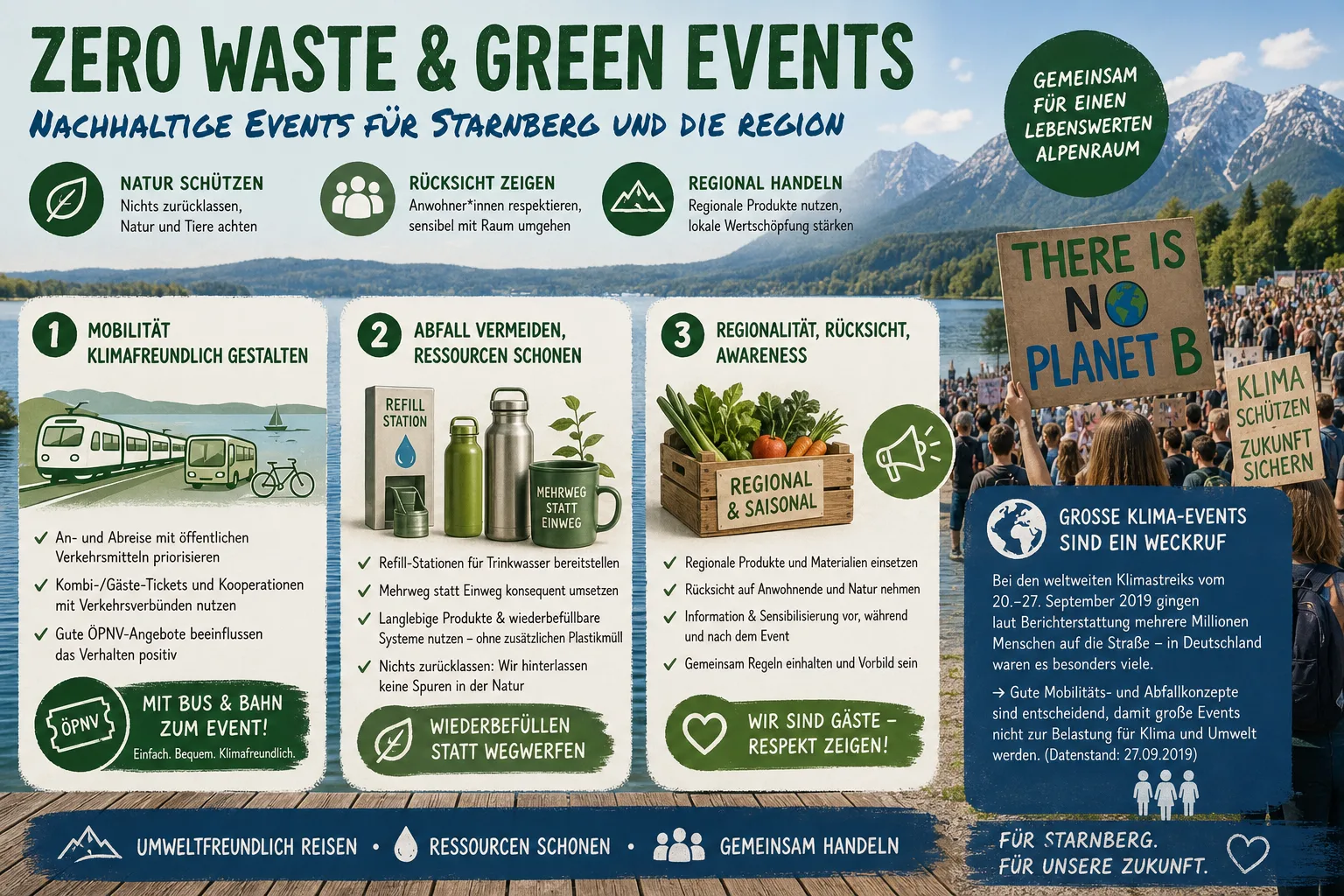
- Mobility: How guests arrive (train, bus, bike, car) and how well the return journey is organized.
- Waste Prevention: Whether single-use products are avoided and reusable/refill systems are consistently implemented.
- Regional Value Creation: Whether catering, services, and materials come from the region, thus reducing transport distances.
Especially by the water, waste prevention is more than "cleaning up": every avoided package reduces the risk of lightweight packaging blowing away or ending up near the shore. Green Events thus protect nature, animals, and the quality of stay – and at the same time strengthen Starnberg's image as a responsible event location.
Climate-Friendly Mobility: The Biggest Lever for Future Events
At many events, a large part of the environmental impact arises from arrival and departure. In Starnberg, this is particularly important because visitor flows can concentrate towards the train station, lake access points, and city center. A good mobility concept makes sustainable travel the easiest option.
This Is How Public Transport, Cycling, and Sharing Become the Standard Choice
- Arrival Info as a Mandatory Part of Every Event Communication: On websites, tickets, posters, and social media, mention public transport/cycling first, then cars.
- Combined Offers: Where possible, design tickets so that public transport is "included" (e.g., references to suitable connections, time windows, last departures).
- Bicycle-Friendly Infrastructure: Clearly visible, secure parking areas near entrances; for larger formats, additional temporary bike parking spaces.
- Shuttle Logic Instead of Individual Traffic: If locations are not central: bundled arrivals and departures (shuttle) as an alternative to many individual trips.
- Parking Management: If cars are necessary, clear parking zones and communication to avoid search traffic and wild parking.
Practical Tip for Planning: Include a mobility section in every schedule and safety concept: expected types of arrival, return plan, signage, and staff/contact persons for visitor guidance.
Zero Waste by the Lake: Avoiding Waste Before It Arises
Zero Waste does not mean "zero waste at any cost," but: systematically reducing waste, prioritizing reusable options, and keeping residual waste small. For future events in Starnberg, three building blocks are particularly effective.
1) Reusable as Standard (Drinks, Food, Distribution)
Reusable cups, dishes, and cutlery visibly reduce single-use waste – especially for drinks and food. The key is a simple return system:
- Clearly communicate deposit (amount, return locations, return times).
- Place return "on the way out" so no one has to search.
- Coordinate washing and logistics processes with service providers in advance so that reusable options work smoothly in operation.
2) Refill & Tap Water: Fewer Single-Use Bottles
Refill options (e.g., water stations, refill points) help avoid single-use bottles. For this to work, you need:
- clearly visible refill points on central routes,
- clear signs ("Fill your bottle here"),
- clean, regularly supervised distribution points.
3) Separation Systems That People Use Intuitively Correctly
Where waste is unavoidable, the quality of sorting determines recyclability. Few, clear fractions with good signage have proven effective:
- Residual (keep as small as possible),
- Packaging,
- Paper,
- Organic (only if it can really be separated cleanly in the process).
An effective detail: always set up waste islands as a set (instead of single bins), so that no one throws incorrectly "for lack of an alternative."
Regional, Seasonal, Efficient: How Upcoming Events Become Economical and Sustainable
Green Events not only strengthen environmental goals but can also involve regional businesses and professionalize processes. For future events in Starnberg, it is worthwhile to focus on three areas:
Regional and Seasonal Catering
- Menu planning according to the season (less cooling effort, better availability).
- Beverages and food with short delivery routes, if possible in reusable containers.
- Portion and replenishment planning to reduce food waste.
Energy: Reduce Demand, Operate Technology Sensibly
- Prefer LED lighting and efficient sound/stage technology.
- Plan operating times realistically (lights/sound not longer than necessary).
- Design setup so that routes are short and cooling/heating does not "work against open spaces."
Decoration & Materials: Borrow, Reuse, Avoid
- Rental decorations, modular signage, and reusable banners instead of single-use prints.
- Material selection with a view to durability and recyclability.
- Reduce giveaways; preferably useful, durable alternatives or do without them entirely.
Consideration, Rules, Awareness: So That Sustainability Works in Practice
Sustainability at future events succeeds not only through technology and materials but also through clear rules, good communication, and friendly implementation on site.
Communication That Really Gets Through
- In Advance: Briefly, concretely, and repeatedly explain travel options, reusable/deposit logic, and waste separation.
- On Site: Signage at key points (entrance, distribution points, waste islands, returns).
- Staff: A small "Green Team" as approachable help reduces incorrect disposal and conflicts.
Cooperation & Neighborhood
In Starnberg, the acceptance of events is closely linked to consideration for residents. For upcoming events, it is worthwhile to:
- coordinate early on regarding spaces, disposal, visitor guidance, and quiet times,
- have a complaints and contact channel during the event,
- clear route guidance to relieve sensitive areas.
Checklist for Planning: Green Event in Starnberg (Future) Step by Step
1) Concept (Before Detailed Planning)
- Define goals: reusable quota, waste separation, mobility priorities.
- Choose event format so that public transport and cycling are realistically possible.
- Plan catering and materials with reusable/borrowed options from the start.
2) Planning & Logistics
- Fix reusable service including washing/return concept.
- Plan waste islands (number, locations, signage, supervision).
- Set refill concept (locations, supervision, hygiene procedures).
3) Communication
- Prominently place travel information (website, ticket, entrance areas).
- "How reusable works" and "How to separate correctly" as short, positive instructions.
- Notes for the lake and shore area: leave nothing behind, use paths, be considerate.
4) Implementation
- Make Green Team visible (e.g., vests/badges, clear contact point).
- Regularly check waste islands to keep separation clean.
- Closely manage return and deposit processes so reusable options do not "disappear."
5) Follow-Up (For the Next Edition)
- Document types and amounts of waste (at least: residual vs. separated fractions).
- Collect feedback from guests, residents, and service providers.
- Set concrete improvements (e.g., more return points, better signage, better bike guidance).