
Jacob de Haan
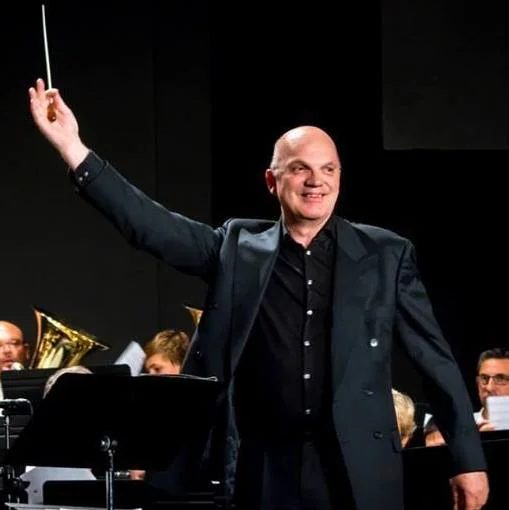
Image from Wikipedia
Image from Wikipedia
Jacob de Haan – The Master of Modern Wind and Choral Music
A Composer Between Emotion, Timbre, and International Stage Presence
Jacob de Haan, born on March 28, 1959, in Heerenveen in the Dutch province of Friesland, is one of the most influential voices in contemporary wind and choral music. His career intertwines composition, arrangement, conducting, and educational practice into an artistic profile that is heard and performed worldwide. From an early age, a unique style formed from musical training, experience in wind orchestras, and church music shaped by a combination of power, melody, and dramatic clarity. (de.wikipedia.org)
Early Years: Music as a Way of Life
De Haan grew up in a musically rich environment: his father was an instrument maker, and young Jacob received early training in piano and cornet. As a teenager, he played flügelhorn in the Brass Band Pro Rege from Heerenveen and composed his first works for brass instruments and piano at the age of 14. At 16, he took on the role of organist in a Reformed congregation and delved into both Dutch and international organ literature, which later influenced his wind instrument language. (de.wikipedia.org)
This early connection between practice and composition significantly shaped his artistic development. For de Haan, music was never an abstract theory but a lived experience in the ensemble, in church, and on stage. This is precisely where the melodic immediacy that makes his works so accessible to musicians and audiences arises. (de.wikipedia.org)
Education and Craftsmanship
Jacob de Haan received his formal education at the Music Academy in Leeuwarden, where he graduated in School Music and Organ; Wikipedia also mentions studies with Hiepko H. Boer, Henk van Loo, Piet Post, and Jan Jongepier. He subsequently taught at various Dutch music schools and increasingly focused on composition and arranging. This dual role as an educator and creator sharpened his perspective on playability, sound balance, and didactic function. (de.wikipedia.org)
On his official website, de Haan is described as a contemporary composer who particularly focuses on wind music and vocal works. It mentions numerous commissioned works, compositions for choir, wind orchestra, and soloists, as well as a global presence as a guest conductor and juror. Thus, his artistic authority derives not only from repertoire but also from lived international practice. (jacobdehaan.com)
The International Breakthrough with “Oregon” and “Concerto d’Amore”
His international breakthrough is attributed in the biography on his website to the piece Oregon. Concurrently, Concerto d’Amore developed into his most performed work worldwide; it combines Baroque, pop, and jazz elements into a easily recognizable, dramatically closed form. The fact that this piece was originally written for the music association Excelsior in Nijland shows how closely de Haan's local musical practice and global impact are intertwined. (jacobdehaan.com)
Concerto d’Amore exemplifies his musical career: it starts with a majestic, Baroque gesture, opens up into an energetic pop phase, and returns to a swinging finale through a characteristic adagio. It is this mixture of classical formal security and popular directness that explains why de Haan is considered a crowd-puller and repertoire composer in the wind music scene. (jacobdehaan.com)
Aesthetic of Work: Melody, Emotion, and Cinematic Sound Language
The official website describes de Haan's music as a blend of classical and modern influences, often with cinematic style connections. His works frequently emerge from improvisation at the piano; de Haan describes this process as creative brainstorming, from which structure and instrumentation gradually develop. The result is a tonal language that remains emotionally charged while also appearing clearly organized. (jacobdehaan.com)
Equally important is the balance between accessibility and sophistication. De Haan writes works for various levels of difficulty, from didactic materials for beginners to challenging concert pieces, marches, and arrangements of classical originals and chorales. This range makes his discography attractive to schools, amateur orchestras, professional ensembles, and choirs alike. (jacobdehaan.com)
Choral Music, Masses, and Sacred Formats
A significant part of his oeuvre consists of sacred and vocal music. Outstanding works include Missa Brevis and Missa Katharina, both of which have gained recognition as successful and frequently performed choral works. Additional compositions such as Cantica de Sancto Benedicto, The Gospel Mass, and Missa Santa Cecilia underscore his affinity for liturgical forms and celebratory choral sonority. (de.wikipedia.org)
With Missa Katharina, he won a composition competition of the Dr.-Dazert-Stiftung in collaboration with the International Music Association and Euregio via salina in 2007; the premiere took place in the Basilica of Ottobeuren. Such milestones demonstrate his authority not only as a wind music composer but also as a creator of larger sacred forms with programmatic depth. (de.wikipedia.org)
Style Profile: Between Tradition, Popularity, and Dramaturgy
The core of Jacob de Haan's style lies in emotional directness. His music uses clear themes, vivid harmonies, and often cinematic dramaturgy that evokes imagery in the mind while guiding ensembles with precision. His official website emphasizes that his works are known worldwide, particularly for their "film-music-like combinations of styles." (jacobdehaan.com)
Additionally, his love for opera and Richard Wagner reflects in his preference for long arcs, thematic recurrence, and expressive building. His sources of inspiration are multifaceted: travel, nature, poetry, and other art forms all flow into his compositions. This leads to music that remains culturally connecting while also carrying a distinctive signature. (de.wikipedia.org)
Awards, Reputation, and International Presence
In 2018, Jacob de Haan received the Buma Classical Award and the Buma Wind Music Award; as early as 2003, he was honored with a music award from the regional broadcasting service of his home province for his entire body of work. These awards mark not only artistic recognition but also the lasting impact of his oeuvre on European wind music culture. (de.wikipedia.org)
The official website also documents his enormous international activity: de Haan is regularly invited as a guest conductor, gives masterclasses, holds lectures, and acts as a juror in competitions. According to the website, his work reaches numerous countries in Europe as well as Peru, Brazil, Colombia, South Korea, Australia, Singapore, and the USA. This makes him not only a composer but also a cultural ambassador of a vibrant, globally connected wind music scene. (jacobdehaan.com)
Current Projects and Publications
New publications for 2026 highlighted on the official website include Happy Harmony, Beauty of Nature, and The Fairy Tale King. In addition, Tasmania is mentioned as a compulsory piece for the 4th Division of the Open Dutch Fanfare Championships 2027. These notes show that de Haan remains productive even after decades in the business and continuously expands his repertoire. (jacobdehaan.com)
The new works mentioned there underline his ongoing sensitivity for programmatic titles and instantly comprehensible sound ideas. The Fairy Tale King, for instance, reflects the life of Ludwig II of Bavaria in fairytale-like, romantic, yet martial and dramatic colors. Thus, de Haan remains a composer who translates narrative motives into concise music. (jacobdehaan.com)
Discography, Catalog, and Reception
According to the official website, de Haan's catalog consists of 177 compositions, 976 guest conducting appearances, activities in over 30 countries, and 47 years of experience. These figures illustrate the breadth of his catalog and the strong presence of his name in international wind orchestra and choral repertoire. MusicBrainz and Wikipedia further list numerous works, including symphonies, choral music, and stage compositions, which secure his place in the modern repertoire. (jacobdehaan.com)
The reception of his work follows a clear pattern: musicians and ensembles appreciate the emotional impact, stylistic transparency, and stage effectiveness of his music. The official website features numerous positive feedback on concerts, rehearsals, and performances, describing de Haan's music as inspiring, precise, and touching. This resonance explains why his pieces are not only heard but continuously revived. (jacobdehaan.com)
Conclusion: A Composer with a Broad Horizon and Instantly Recognizable Sound
Jacob de Haan is intriguing because his music is equally crafted with mastery, emotionally open, and culturally widely connected. He blends the discipline of an organ and wind orchestra composer with the imagination of a sound poet, shaping a distinctive profile from melody, dramaturgy, and timbre. Those seeking contemporary wind music with character, musical depth, and strong audience impact will find an impressive oeuvre in his work. (jacobdehaan.com)
Especially in live performances, his works unfold the impact for which they were written: presence, energy, and emotional immediacy. Jacob de Haan remains an artist to be experienced not just in the catalog, but in the concert hall. (jacobdehaan.com)
Official Channels of Jacob de Haan:
- Instagram: No official profile found
- Facebook: No official profile found
- YouTube: No official profile found
- Spotify: No official profile found
- TikTok: No official profile found